RVPO:基于方差正则化的风险敏感对齐
现有无评论者RLHF方法通过算术平均聚合多目标奖励,易导致约束忽视:单一目标的高分可能掩盖其他关键目标(如安全性或格式)的严重失败,从而隐藏影响可靠对齐的低性能瓶颈奖励。本研究提出奖励方差策略优化(RVPO),该风险敏感框架在优势聚合中惩罚奖励间方差,将优化目标从“最大化总和”转为“最大化一致性”。分析表明,RVPO能有效识别并提升瓶颈奖励的贡献,在安全性、格式遵循等多目标对齐任务中实现更均衡的策略优化。
当多数RLHF在‘求总分’,这篇Apple论文告诉你得分方差也致命,做安全对齐的人会看到新的损失函数怎么把一致性也纳入训练目标。
AuthorsIvan Montero, Tomasz Jurczyk, Bhuwan Dhingra
Current critic-less RLHF methods aggregate multi-objective rewards via an arithmetic mean, leaving them vulnerable to constraint neglect: high-magnitude success in one objective can numerically offset critical failures in others (e.g., safety or formatting), masking low-performing “bottleneck” rewards vital for reliable multi-objective alignment. We propose Reward-Variance Policy Optimization (RVPO), a risk-sensitive framework that penalizes inter-reward variance during advantage aggregation, shifting the objective from “maximize sum” to “maximize consistency.” We show via Taylor expansion that a LogSumExp (SoftMin) operator effectively acts as a smooth variance penalty. We evaluate RVPO on rubric-based medical and scientific reasoning with up to 17 concurrent LLM-judged reward signals (Qwen2.5-3B/7B/14B) and on tool-calling with rule-based constraints (Qwen2.5-1.5B/3B). By preventing the model from neglecting difficult constraints to exploit easier objectives, RVPO improves overall scores on HealthBench (0.261 vs. 0.215 for GDPO at 14B, p < 0.001) and maintains competitive accuracy on GPQA-Diamond without the late-stage degradation observed in other multi-reward methods, demonstrating that variance regularization mitigates constraint neglect across model scales without sacrificing general capabilities.
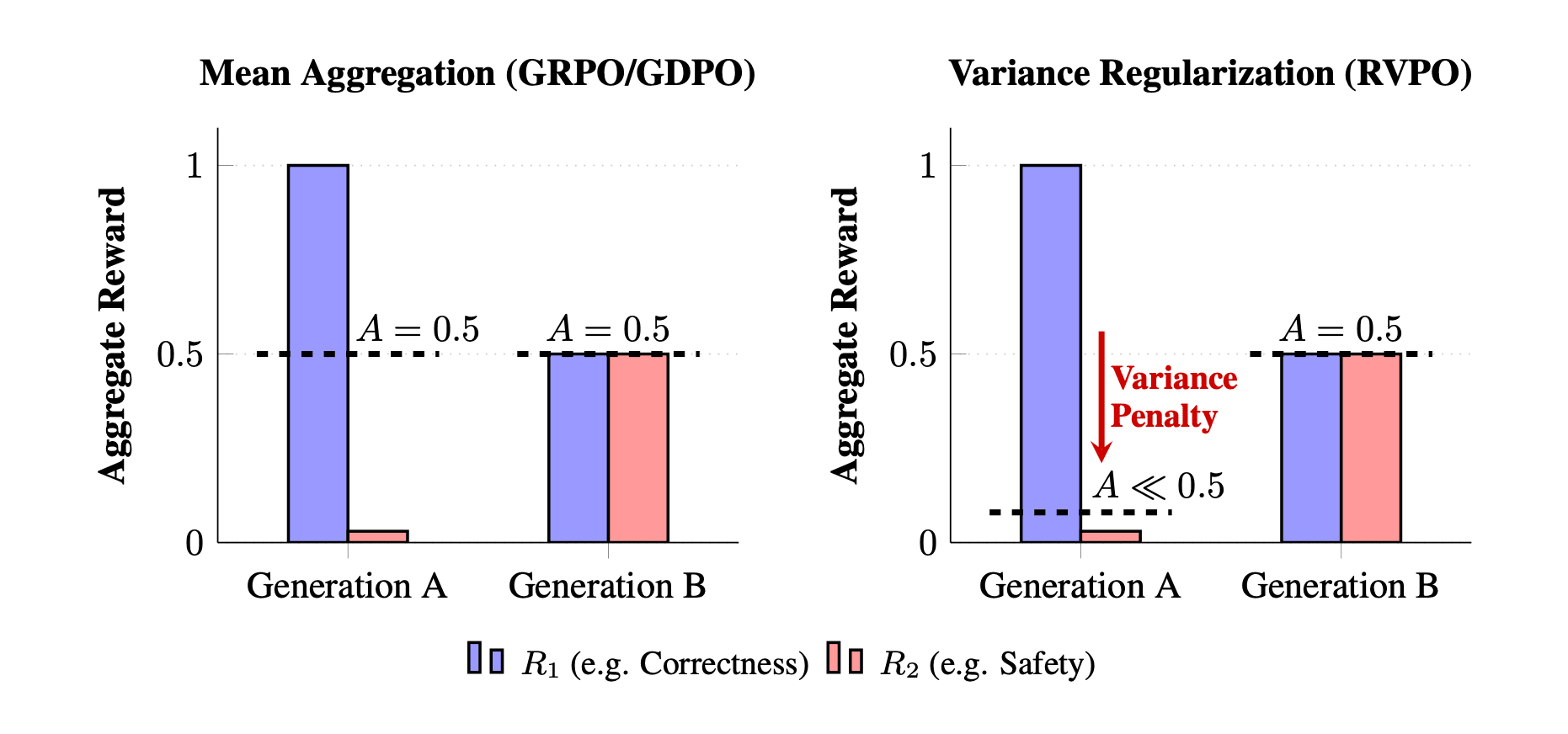
Figure 1: Constraint Neglect in Multi-Objective RLHF. (Left) Mean aggregation (GRPO/GDPO) treats outputs with critical constraint failures (Gen A) as mathematically identical to balanced outputs (Gen B), blinding the optimizer to critical failures. (Right) RVPO applies a soft-min operator to penalize inter-reward variance, heavily discounting Gen A to enforce bottleneck constraints.
Related readings and updates.
Reinforcement Learning from Human Feedback (RLHF) is an effective approach for aligning language models to human preferences. Central to RLHF is learning a reward function for scoring human preferences. Two main approaches for learning a reward model are 1) training an explicit reward model as in RLHF, and 2) using an implicit reward learned from preference data through methods such as Direct Preference Optimization (DPO). Prior work has shown…
Most bandit algorithms assume that the reward variances or their upper bounds are known, and that they are the same for all arms. This naturally leads to suboptimal performance and higher regret due to variance overestimation. On the other hand, underestimated reward variances may lead to linear regret due to committing early to a suboptimal arm. This motivated prior works on variance-adaptive frequentist algorithms, which have strong…
来源:Apple Machine Learning Research(RSS) · machinelearning.apple.com